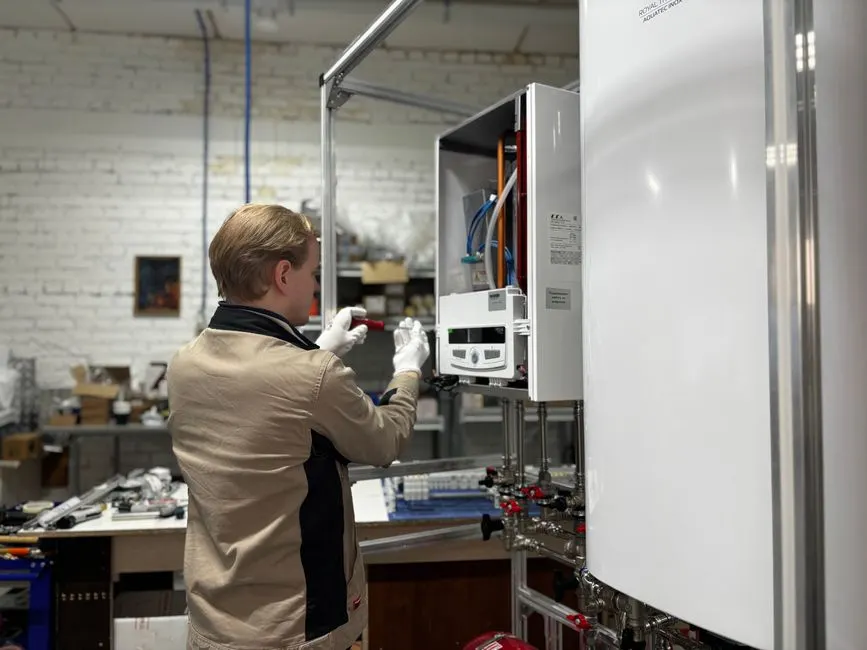
A water heater leaking from the bottom almost always means the tank itself has failed, the drain valve is loose, or the temperature and pressure relief valve is discharging. In Austin's hard water, tank failures typically show up after 8 to 12 years of service, and once the steel shell cracks, no patch holds. The rest of this post walks through how to confirm which of those three problems you have, what a repair costs in 2026, and when it's time to stop troubleshooting and call us.
Water heater leaking from bottom Austin TX is one of the most common calls we run between November and February, when incoming water temperatures drop into the 50s and the tank works harder to keep up. If you're standing in a puddle right now, shut off the cold inlet valve on top of the tank and the gas valve or breaker before you read further.
The short answer: where the water is actually coming from
Water pooling under a heater can originate from four places, and only one of them is the tank itself. Before you assume the worst, dry the floor completely and watch where the next drop appears.
- Drain valve - the spigot at the base of the tank. A worn washer or a valve that was bumped during a flush will drip steadily.
- T&P relief valve - the brass valve with a pipe running down the side. If it's weeping, the tank is over-pressurized or overheating.
- Inlet and outlet fittings - the nipples on top. Water runs down the tank wall and looks like a bottom leak by the time it hits the floor.
- The tank shell - a crack in the inner steel liner. This is the one that ends the heater's life.
Water heater leaking from bottom in Austin TX is a repair problem, not a maintenance item, once you've ruled out the first three. A leaking tank cannot be welded, sealed, or patched from the outside.
Why is my water heater leaking from the bottom in Austin TX?
Austin's municipal water runs hard - roughly 8 to 12 grains per gallon of calcium carbonate depending on which treatment plant serves your address - and that mineral load is the single biggest reason tanks fail here earlier than the manufacturer's rating suggests. Every gallon that enters the tank leaves behind a little scale. Over 8 to 10 years, that sediment layer insulates the burner from the water, overheats the steel floor of the tank, and stress-cracks the glass lining.
Three other local factors shorten tank life:
- Expansion and contraction. Austin swings from 105°F summer afternoons to 30°F winter mornings. Metal tanks and the copper fittings attached to them expand and contract with every heating cycle, and pinhole leaks form at the seams.
- High incoming pressure. Many older neighborhoods sit on lines that push 80 to 90 PSI. Anything above 80 PSI accelerates tank wear. A $40 expansion tank and a pressure-reducing valve solve that.
- Age. The average tank in an Austin home lasts 8 to 12 years. If yours is stamped 2014 or earlier, a bottom leak is a replacement conversation, not a repair.
We see the same pattern in rental stock and older bungalows across Plumbing in Hyde Park, where original 1950s plumbing meets modern high-pressure mains. The tanks fail at the bottom seam first because that's where sediment settles.
How to tell a tank failure from a fitting leak
A tank failure and a fitting leak look identical from three feet away, so here's the two-minute test we run on every call. It saves homeowners from replacing a heater that only needed a $12 washer.
Step 1: Kill the water and dry the floor
Close the cold inlet valve on top of the tank. Open a hot tap at the nearest sink to relieve pressure. Towel the base dry and wait 10 minutes.
Step 2: Watch the source
If water reappears at the drain valve threads, it's the valve. If it appears at the T&P discharge pipe, it's a pressure or temperature issue. If it seeps from the seam where the tank meets the base pan, the liner has failed.
Step 3: Check the top
Run a dry finger along the inlet and outlet nipples. Any moisture there means the leak is running down the outside of the tank and pooling at the bottom - a much cheaper fix than a new heater.
If the tank itself is the source, we move straight to replacement. Our team handles water heater repair Austin TX same-day, including hauling the old unit out and disposing of it.
Can I fix a leaking water heater myself in Austin Texas?
You can fix a leaking drain valve or a weeping T&P valve yourself if you're comfortable with a wrench and a bucket. You cannot fix a cracked tank, and any attempt to seal one with epoxy or JB Weld will fail within days once the tank heats back up.
Here's what's reasonable for a homeowner to handle:
- Replacing the drain valve washer (about $5 in parts, 30 minutes).
- Flushing 2 to 3 gallons from the tank to clear sediment at the bottom.
- Testing the T&P valve by lifting the lever briefly - if it drips afterward, the valve needs replacing.
What you should not do: open the anode port, disconnect gas lines, or attempt to weld or braze a tank seam. Those are jobs for a licensed plumber, and in Texas, gas work requires a licensed technician. If you're not sure which failure you have, our leak detection Austin TX service will pinpoint the source in under an hour.
How much does it cost to fix a leaking water heater in Austin TX?
Typical 2026 pricing in Austin runs $150 to $350 for a drain valve or T&P valve replacement, and $1,200 to $2,400 for a full tank replacement depending on size, fuel type, and whether code upgrades are needed. Tankless replacements run higher, $2,800 to $4,500 installed.
What drives the number:
- Tank size. A 40-gallon gas heater sits at the low end; a 75-gallon power-vent unit sits at the top.
- Fuel type. Gas replacements require venting checks and a new flex connector. Electric swaps are faster.
- Code upgrades. Since 2015, Texas code has required an expansion tank and a pan with a drain line on most replacements. If your old install lacks those, add $150 to $300.
- Permits. The City of Austin requires a plumbing permit for water heater replacement. We pull it for you.
- Emergency timing. After-hours calls run 25% to 40% higher than weekday rates.
If you're weighing repair versus replacement on a heater older than 8 years, replacement is almost always the better spend. A $300 valve job on a 12-year-old tank buys you six months.
Is a leaking water heater dangerous in Austin Texas?
A leaking water heater is dangerous in three specific ways, and two of them are serious. Water near the base of a gas heater can extinguish the pilot and allow gas to accumulate. Water on a concrete floor near an electrical panel or a 240-volt connection creates a shock hazard. And a tank that ruptures catastrophically can release 40 to 80 gallons in under five minutes.
The slow leak is the one that costs the most. We've pulled up soaked subfloor, replaced swollen baseboards, and treated mold in closets behind heaters that had been dripping for weeks. Water damage repairs routinely run $2,000 to $8,000 - far more than the heater itself.
If your heater sits in an attic, a closet, or above a finished ceiling, treat any bottom leak as an emergency. Call us for emergency plumbing Austin TX rather than waiting until morning.
Common mistakes we see on leaking water heater calls
Homeowners make the same four mistakes on leaking heaters, and each one turns a $200 repair into a $2,000 problem. Here's what to avoid.
- Ignoring the drip because it's slow. A tank seam leak never seals itself. It grows.
- Turning the temperature up to compensate. Higher temperature means higher pressure, which makes the leak worse and can trip the T&P valve.
- Using epoxy or sealant on the tank. It fails within a week. The tank is under 60 to 80 PSI of internal pressure.
- Replacing the heater without checking the anode rod. A $30 anode swap every 4 to 5 years can double the life of a tank. Most homeowners never do it.
One more: don't drain the tank and leave it empty. A dry steel tank rusts from the inside out in a matter of days.
When to call a professional
Call a licensed plumber the moment you confirm the leak is coming from the tank seam, the T&P valve keeps discharging after you've lowered the temperature, or you smell gas near the unit. Those are not homeowner fixes.
Our team at TEST- Austin Plumbing Co handles water heater diagnostics, repair, and replacement across the Austin metro. We find the leak, fix it or replace the unit, test the new install under pressure, and haul the old tank away. You get a flat upfront price before we start.
If you're in a newer build out near the toll road, we also cover Plumbing in Cedar Park and the surrounding suburbs with the same same-day scheduling.
Frequently Asked Questions
Why is my water heater leaking from the bottom in Austin TX?
Nine times out of ten it's a failed tank liner, a worn drain valve, or a T&P valve releasing pressure. Austin's hard water accelerates tank corrosion, so heaters here often fail at the bottom seam between years 8 and 12.
Can I fix a leaking water heater myself in Austin Texas?
You can replace a drain valve washer or a T&P valve yourself in about 30 minutes. You cannot repair a cracked tank - that requires full replacement by a licensed plumber. Gas line work also requires a licensed technician in Texas.
How much does it cost to fix a leaking water heater in Austin TX?
Valve repairs run $150 to $350. Full tank replacement runs $1,200 to $2,400 installed in 2026, including permit, expansion tank, and haul-away. Tankless replacements start around $2,800.
Is a leaking water heater dangerous in Austin Texas?
Yes, in three ways: gas accumulation if the pilot goes out, electrical shock near a 240-volt connection, and water damage that can exceed $5,000 if the leak runs for weeks. Treat any tank-seam leak as urgent.
How long does a water heater last in Austin?
Eight to twelve years on average. Austin's hard water shortens that. Flushing the tank annually and replacing the anode rod every 4 to 5 years can push it toward the 12-year mark.
Get help with Plumbing in Austin
A leaking water heater doesn't fix itself, and every hour it drips adds to the damage. Call TEST- Austin Plumbing Co at (555) 010-0199 and we'll be on our way with the parts to repair or replace your unit the same day.